
InkPavo
A letterpress business card brand for customers abroad. From zero to $5k in sales in two weeks. I'm a co-founder, working across product, engineering and growth: storefront, design editor, operations console, AI tooling, SEO and GEO.
- Type
- Web
- Role
- Lead
- Status
- Active
- Tech
- Next.js 16 React 19 TypeScript Medusa v2 PostgreSQL Redis Vite MCP LLM tool calling Chatwoot PayPal Docker GitHub Actions Playwright
- Started
- Oct 2026
InkPavo is a letterpress business card brand. It also makes postcards, stickers and flyers, for customers in the US, Europe and elsewhere.
I’m a co-founder, working across product, engineering and growth. The brand started from zero in October 2026 and reached $5k in sales in two weeks.
The system has four parts: a server-rendered storefront with an in-browser design editor, a commerce backend, an operations console for staff, and an AI layer that serves both customers and staff.
Product
Catalog and pricing model. Four product lines, each with its papers, finishes, sizes and quantities. The production spec sheets became one rule set: which stock takes which finish, what each quantity costs, and the stated reason when a combination cannot be made. One pricing engine serves the product page, the editor, the cart, the chat assistant and the console, so a quote is the same number everywhere.
Six markets. US, UK, Europe, Canada, Australia and New Zealand. Each market has its own currency, price list, URL prefix and units (inches and pt, or millimetres and gsm). Product data is kept once and converted per market at render time.
Three ways to order. Configure on a product page, start from a template, or design from a blank card in the editor. All three resolve to the same line item and the same price.
Competitive pricing. A competitor’s US catalog, 48 product series and 2,209 quantity and price points, went into an interactive tool for comparing price curves against ours.
Engineering
Storefront
Next.js 16 with React 19, server-rendered. Content pages are cached by tag and revalidated on demand: when staff save a change in the back office, the backend calls the storefront’s revalidate endpoint and only the affected pages rebuild. Shipping estimates are computed from the weight of the selected configuration and the destination country.
Design editor
A browser-based editor for print: multiple text, shape and image objects on both sides, with drag, scale, rotate, undo and redo, a 3D preview, and a finish assigned per object (letterpress ink, hot foil, deboss, emboss). Manufacturing constraints are enforced in the editor as the customer works, for example a limit of three spot colours per side, or finishes that cannot be combined on one object. Drafts autosave locally, with image data in IndexedDB so large uploads do not exhaust storage.
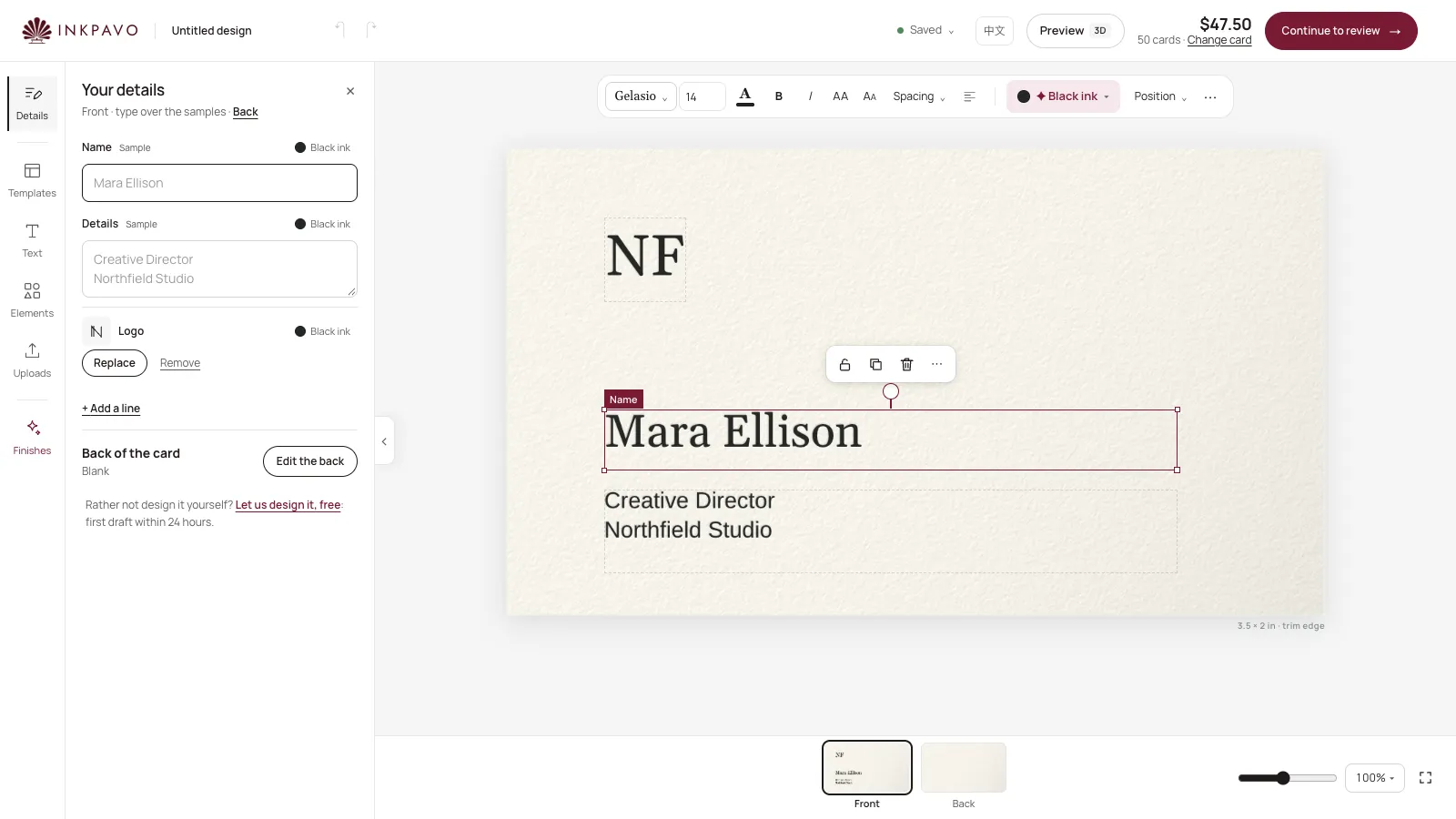
Every object carries its own finish, and the price in the corner is the price at checkout.
Template library
Templates live in the database with categories and revision history, and are managed from the console; publishing one needs no deploy. Each template is checked automatically before it can go live, and its attributes are derived by the system instead of typed in: compatible products and thicknesses, finishes, colours per side, fonts, and prices across all six markets. The first 31 templates were rebuilt from a triage of 209 showcase photos.
Commerce backend
Medusa v2 on PostgreSQL and Redis, extended with custom modules for artwork files, production status, quotes, design jobs, invoices, refunds, shipping, product reviews, email logging and PayPal checkout. The backend refuses to start when production PayPal credentials are paired with a localhost storefront.
Operations console
A separate staff application (Vite, React, TypeScript) that talks only to a dedicated console API and never touches the database directly. It covers the order pipeline from artwork review to factory hand-off and dispatch, plus quotes, design jobs, customer records and template management. Every action is written to an action log.
Support and inquiries
Website chat, email and contact forms converge into one conversation per customer on a self-hosted helpdesk, docked into the console so staff see the customer’s orders and quotes beside the thread.
AI layer
Customer-facing assistant. The website chat is answered first
by an LLM with tool calling. Its tools are grounded in the live
system: get_prices runs the same pricing engine as the product
page, and read_page fetches the current text of a public page.
It hands off to a person immediately for order issues, custom
quotes and anything it cannot answer, and leaves a note for staff
that summarises the conversation.
MCP server for the back office. A Model Context Protocol
server exposes the console to AI agents. Every console button is
one entry in an action registry, and both the UI and the agent go
through that registry, so an agent can do what a staff member can
and nothing else. Reads are direct. Writes are two-phase: the
agent prepares an action, the backend returns a preview of what
will happen and what the customer will receive, and the action
runs only after a person confirms it. Access tokens are scoped
(read, act, money), and each action is attributed to the
staff account behind the token.
Infrastructure and quality
Docker deployment with CI/CD on GitHub Actions; merging to main deploys. Uptime monitoring checks the storefront, product pages, the pricing endpoint, the feeds, the console and the chat every one to five minutes and alerts by email. Each user flow has a Playwright acceptance script (checkout, accounts, the editor, shipping estimates), and one of them runs about 40 designs through both the editor and the product page and compares the totals.
Growth
Technical SEO. Server-side rendering, so crawlers receive full
HTML. JSON-LD structured data for products, offers, FAQs,
breadcrumbs, articles and the organization. A generated sitemap,
market-specific URLs, and an llms.txt.
GEO (generative engine optimization). I track whether AI assistants cite and name the brand when buyers ask purchase questions. A fixed question set is re-run across Google AI Overviews, AI Mode, Bing Copilot and Perplexity. For ChatGPT I built a tracing tool on the OpenAI Responses API with web search: it records which queries the model issued, which pages it retrieved and opened, and what it cited, then reports the stage where the brand dropped out of each answer, from “not retrieved” to “named first”. Page changes are prioritised from those results.
Product feeds. Google Merchant Center and Pinterest catalog feeds are generated from one item list, so IDs, titles, images and prices stay consistent across channels.
Analytics. GA4 and Search Console, plus read-only scripts that reconcile sessions against inquiries and orders in the database.
Content and social. The blog, the showcases and the social accounts are updated regularly, with a command-line tool that handles the social content workflow.
Status
The store is live at inkpavo.com and taking orders.