
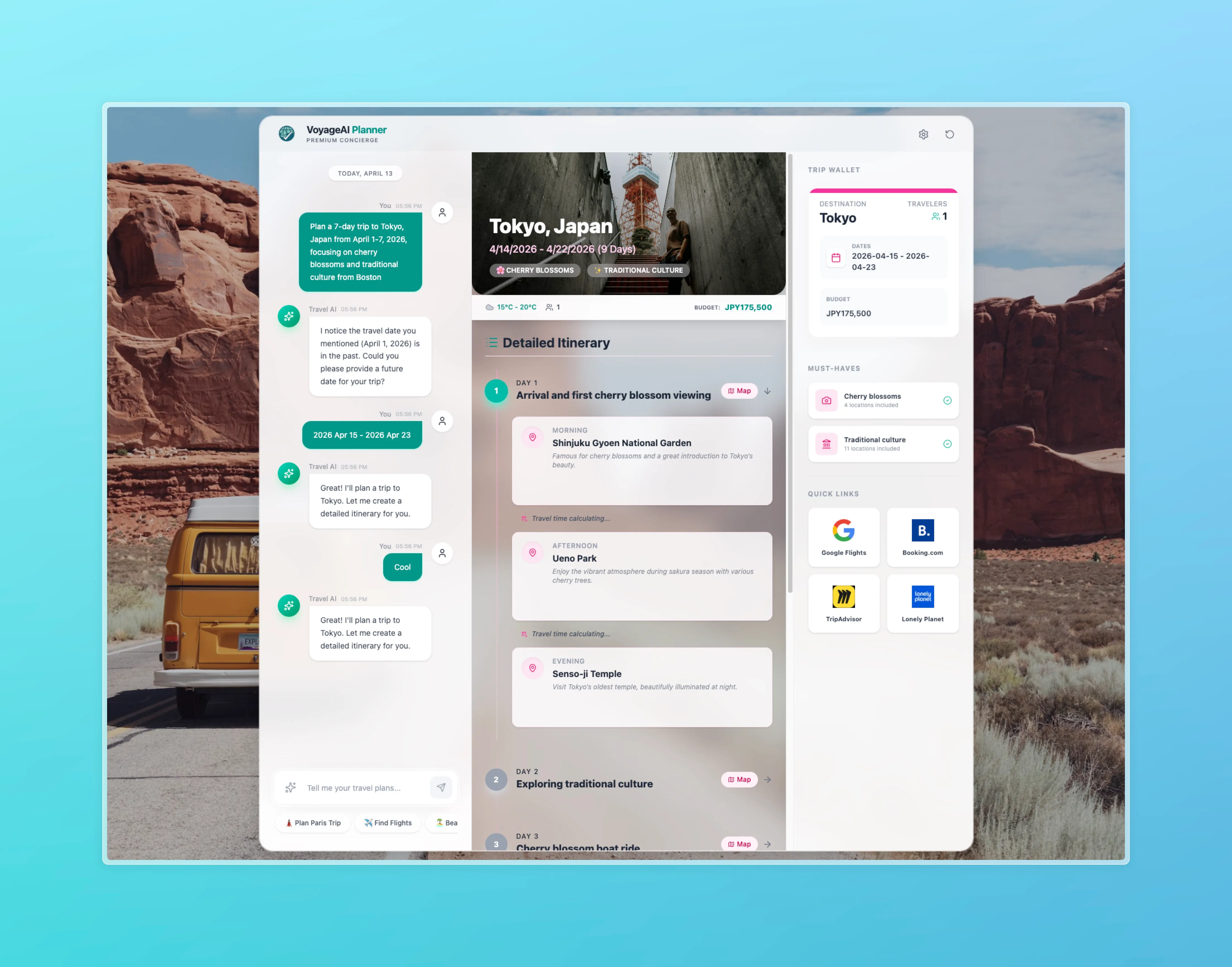
VoyageAI Planner
A multi-agent, LangGraph-powered AI travel companion — built around a security-first, self-correcting workflow.
- Type
- Web
- Role
- Contributor
- Status
- Active
- Tech
- LangGraph LangChain FastAPI Server-Sent Events OpenAI GPT-4 React 19 Vite TypeScript Tailwind v4 TanStack Query
- Started
- Sep 2025
- Ended
- Dec 2025
INFO 7375 · Final Project · Group 6 — Northeastern, Fall 2025.
Overview
VoyageAI Planner turns a single natural-language request like “Plan a 3-day honeymoon to Paris with $2000” into a validated, day-by-day itinerary.
Under the hood, a LangGraph state machine orchestrates
specialized agents — a coordinator, a task decomposer, a tool-using
judge, a synthesizer, and a validator — that can retry, refine, and
self-correct before anything reaches the user. The frontend is a
React chat UI streaming updates in real time via Server-Sent
Events; the backend is a FastAPI service that exposes a single
/chat/stream endpoint powering the whole experience. The constraint
parser is bilingual — the same pipeline extracts destination,
duration, budget, and trip type from both English and Chinese
natural-language requests.
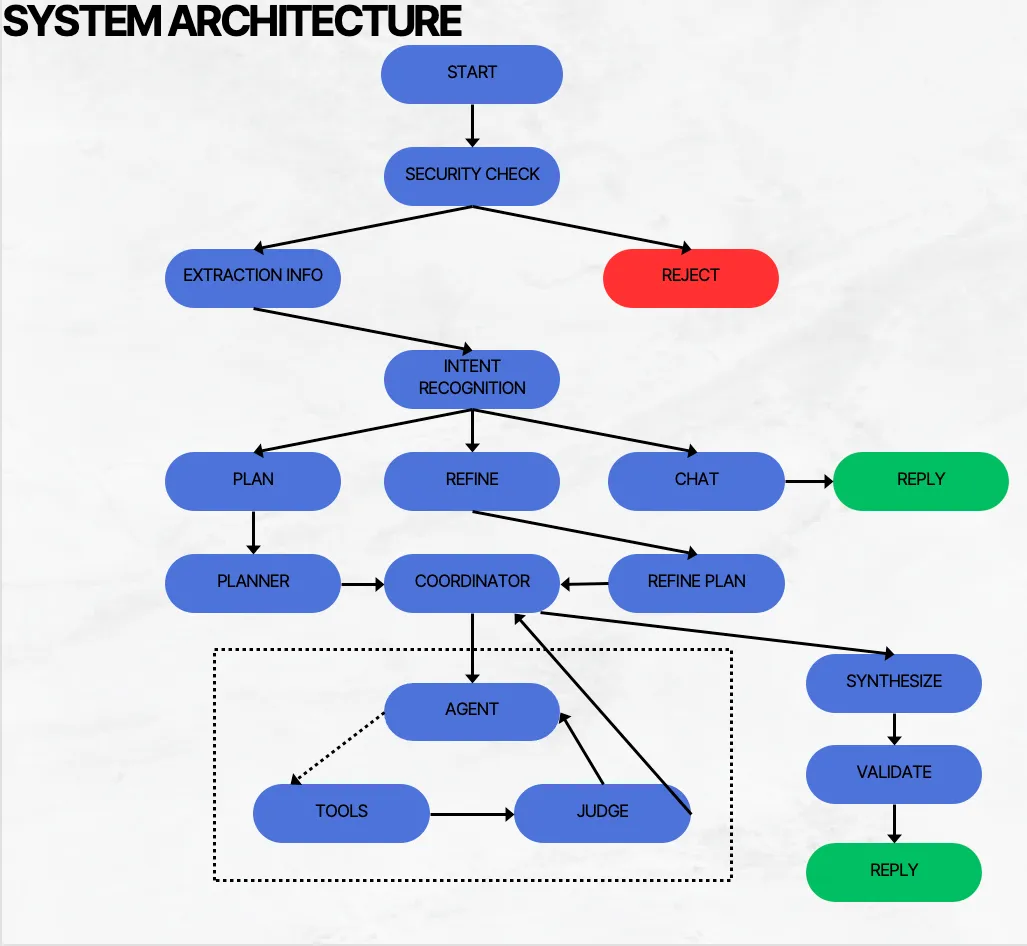
System Architecture
The full graph flow (from an incoming user message to a validated itinerary):
Start
  ↓
Security Check  (Guard — blocks prompt injection / off-topic)
  ↓
Extraction Info  ────→  Reject
  ↓
Intent Recognition
  ↓
[ Plan  |  Refine  |  Chat  ]  ────→  Reply (for Chat branch)
  ↓
Planner → Coordinator (Loop) → Refine Plan
  ↓
┌───────────────────────────────────────┐
│ AGENT LOOP · TOOL USE + SELF-JUDGE    │
│   Agent → Tools → Judge → (loop)      │
└───────────────────────────────────────┘
  ↓
Synthesize
  ↓
Validate  (Retry on constraint violation)
  ↓
Reply
👉 Full interactive architecture diagram (standalone HTML).
What We Did Well
Security-first gate. A dedicated Security Check node sits at
the entry point, filtering prompt-injection and off-topic requests
before any LLM planning work runs — saving tokens and preventing
misuse.
Intent router. One endpoint, four behaviors: plan, refine,
chat, or reply. The Intent Recognition node routes each message
to exactly the sub-graph it needs — no wasted compute on simple small
talk.
Self-correcting agent loop. Tool → Judge → Tool. The Judgement Agent decides whether a sub-task is complete or needs another tool call, with a hard retry ceiling and a fallback path — no infinite loops, no silent failures.
Plan validation node. Every synthesized itinerary passes through a Validator that checks duration, budget, and structural integrity against the original constraints before it ever reaches the user.
Refine, don’t rebuild. A dedicated Refine Plan branch lets users
tweak an existing itinerary (“make day 2 cheaper”) without re-running
the full pipeline — faster and much lower cost.
Streaming UX over SSE. The frontend shows live node progress —
coordinator, judge, synthesize — so users see the agent
thinking instead of staring at a spinner.
Clean, modular graph. Nodes, routers, core state, and utils live in separate packages. Adding a new capability is a matter of registering one node — no tangled monolith.
Bilingual constraint parsing. LLM-powered normalization extracts destination, duration, budget, and trip type from both English and Chinese natural-language requests with the same pipeline.
Stack detail
- Agent: LangGraph + LangChain + OpenAI GPT-4. Nodes are
registered as Python modules under
travel_planner/with separate packages for routers, core state, and tool adapters. - API: FastAPI with a single
/chat/streamServer-Sent Events endpoint that multiplexes node events back to the frontend. - UI: React 19, Vite, TypeScript, Tailwind v4, TanStack Query, and Lucide icons. The chat UI subscribes to the SSE stream and renders each agent node’s progress inline.
My contribution
Group 6 project — specific contribution notes go here.